The Golden Retriever Rule: Alzheimer's vs. Dementia, Finally Explained

Today a patient said to me,
“My sister has severe Alzheimer’s, and she was just diagnosed with dementia, too.”
Somewhere along the line, she had come to understand Alzheimer’s disease and dementia as two separate, additive conditions—like developing diabetes on top of high blood pressure.
I hear some version of this nearly every day. Alzheimer’s, dementia, and MCI are words we use constantly in healthcare, but they’re not nearly as self-explanatory as we sometimes assume.
Which brings us to dogs.
The Golden Retriever Rule
Forget the abstract “dementia umbrella” diagrams you see on clinic wall posters. Here is a simple mental model that actually sticks:
The Golden Retriever Rule
Dementia = Dog
Dementia due to Alzheimer’s disease = Golden Retriever
Every Golden Retriever is a dog. Not every dog is a Golden Retriever.
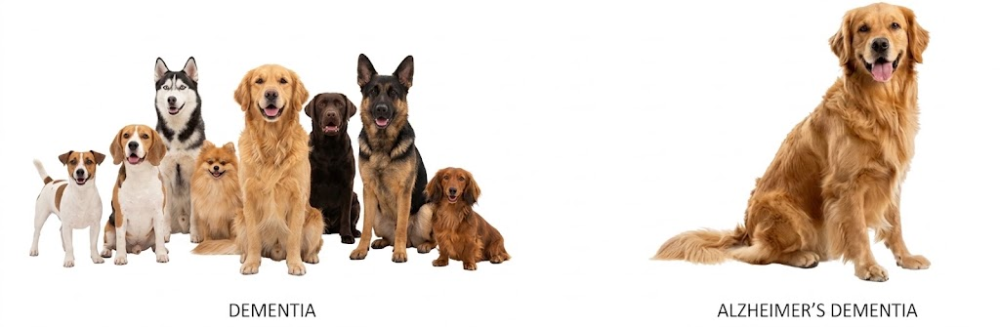
Dementia isn’t a single specific disease. It’s an overall term for a change in memory, thinking, or reasoning that has progressed enough to interfere with independent daily living.1 Alzheimer’s disease is one specific biological disease process that can cause that state.2
Hearing someone say, “She has Alzheimer’s, and now she has dementia too,” sounds a lot like saying:
“We knew she was a Golden Retriever, but the vet just confirmed she’s also a dog.”
It sounds a bit silly framed that way. But the confusion behind it isn’t ridiculous at all. It’s proof that healthcare has done a poor job explaining its own language to the people who need to understand it most.
Expanding the Dog Park
The same logic clears up the rest of the map, too.
Think of dementia as the overall family category, and the specific diseases that cause it as different “breeds”:3
- Dementia due to Alzheimer’s Disease = Golden Retriever
- Dementia with Lewy Bodies = Poodle
- Frontotemporal Dementia (FTD) = Bulldog
- Vascular Dementia = Dachshund
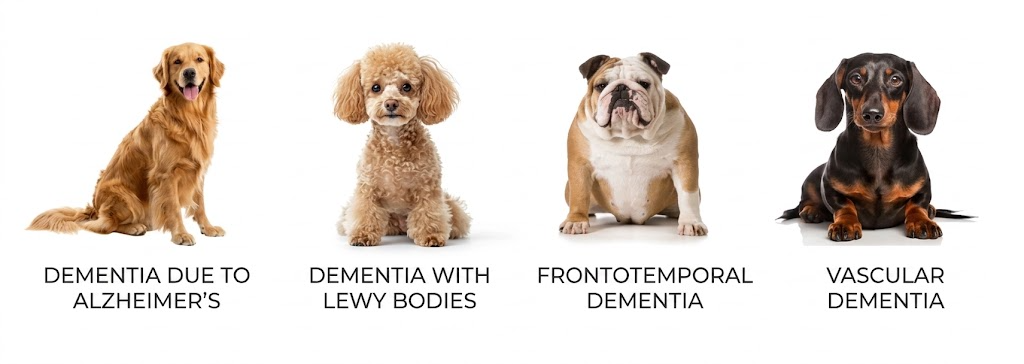
A Poodle isn’t a Golden Retriever, and a Bulldog isn’t a Dachshund. They represent different underlying disease processes. Yet if any of them walk into a room, you instantly recognize them as a dog.
Similarly, Alzheimer’s, Lewy body disease, FTD, and vascular brain changes are different causes. But when any of them progress to the point where they interfere with everyday independence, the term we use for that level of functional change is dementia.1,3
Real human brains are messier than purebred dogs, of course. As people age, it’s very common to have features of more than one disease—like Alzheimer’s pathology and vascular changes—happening at the same time.4 In those cases, you end up with what you might call a “mixed breed.”
The Bottom Line
If families don’t understand the words we’re using, it’s a lot harder for them to navigate what comes next.
When we give someone a diagnosis, we’re handing them the terms they’ll use to understand the rest of their family’s life. The least we can do is give them terms that make sense. I hope this helps.
The next time you hear someone getting tangled up in the medical jargon, just ask:
“Are we talking about the dog, or the Golden Retriever?”
References
- Dickerson BC, Atri A, Clevenger C, et al. The Alzheimer’s Association clinical practice guideline for the Diagnostic Evaluation, Testing, Counseling, and Disclosure of Suspected Alzheimer’s Disease and Related Disorders (DETeCD-ADRD): executive summary of recommendations for specialty care. Alzheimers Dement. 2025;21(1):e14337. doi:10.1002/alz.14337
- Jack CR Jr, Andrews JS, Beach TG, et al. Revised criteria for diagnosis and staging of Alzheimer’s disease: Alzheimer’s Association Workgroup. Alzheimers Dement. 2024;20(8):5143-5169. doi:10.1002/alz.13859
- National Institute on Aging. Infographic: Understanding different types of dementia. Updated June 2025. Accessed August 17, 2026. https://www.nia.nih.gov/health/alzheimers-and-dementia/understanding-different-types-dementia
- Agrawal S, Schneider JA. Vascular pathology and pathogenesis of cognitive impairment and dementia in older adults. Cereb Circ Cogn Behav. 2022;3:100148. doi:10.1016/j.cccb.2022.100148
This article is provided for informational and educational purposes only and does not constitute medical advice. Always consult a qualified healthcare professional for questions about diagnosis, treatment, or your personal health.